Florida Millennium
Photo by Tom Burton
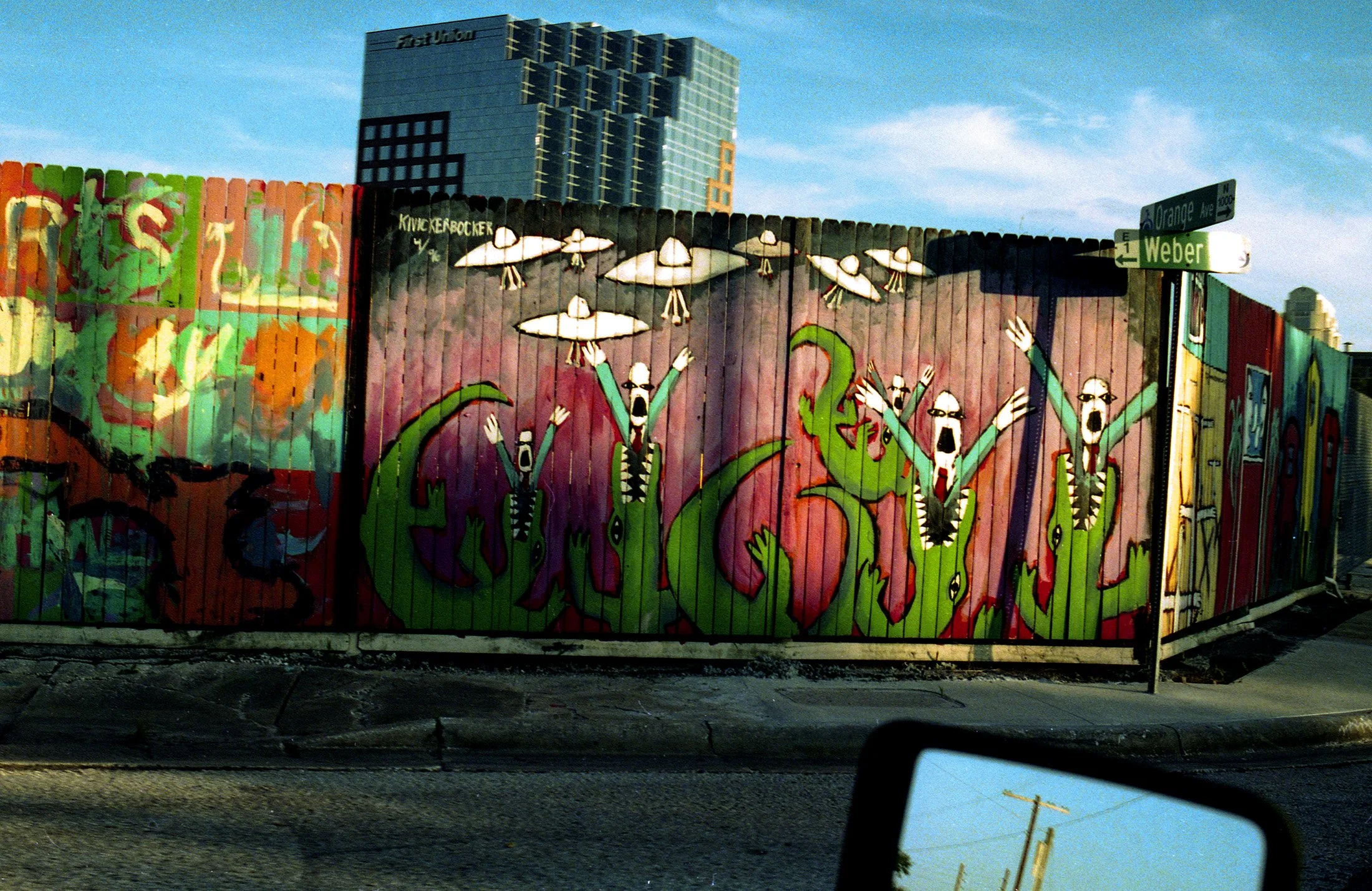
It's probably going to be a bad day at the office if you are eaten by alligators during a UFO invasion.
That brief vision recurs every day for commuters coming into downtown Orlando along North Orange Avenue. If they slow down for the railroad tracks they also will see a floating banana that's bigger than a compact car, a school of toothy piranhas and huge smiling faces.
The fleeting images are paintings on a construction fence that make a mysterious contrast to the Orlando skyline. For drivers zipping by at 30 mph, they are a quirky accent against a backdrop of staid office buildings made of glass and concrete.
The murals are not the result of late-night spray-can attacks, but the specifics of their creation seem as difficult to define as the origins of Stonehenge.
Various sources seem to agree that the original plan was called the Tom Sawyer Project, but it slowed down when the project founder left town. Then the fence became an open space for local artists under the direction of another project leader and the auspices of the Arts Services Council. And then that leader left town, at least for a while.
One person we could find who was part of the creation is Carl Knickerbocker, the Chuluota, Florida artist who painted ''Florida Millennium,'' the fence section that shows men in suits and ties being swallowed whole by alligators.
Even with an eyewitness, the details are sketchy. Admitting that ''memory is the thing I use to forget with,'' Knickerbocker remembers hearing about the mural project two years ago and then waiting for it to start. Finally, he decided to get started on his own and grabbed the prime position on the corner of Orange Avenue and Weber Street. Other painters quickly followed.
It took Knickerbocker five hours to paint ''Florida Millennium.'' He usually takes much more time with real paintings, but it was March, and the weather was getting hot. Paint flew fast and furious.
The inspiration for his spontaneous and perhaps temporary public art was the strange conflicts that Florida experiences as it grows.
''There's a lot of craziness going on,'' says Knickerbocker. ''This is an interesting place to live.''
A version of this story was published in the Orlando Sentinel in October, 1997
By Tom Burton
Three years after the first story about this public art mural, I returned and noticed it had been tagged by another artist. It was late in the day and stormy when I stopped to make the photo, and I apparently decided that a focused strobe would help with lighting. I can’t recall why I thought it made sense to include my hand in the frame, holding the strobe. But I did that. — TWBurton
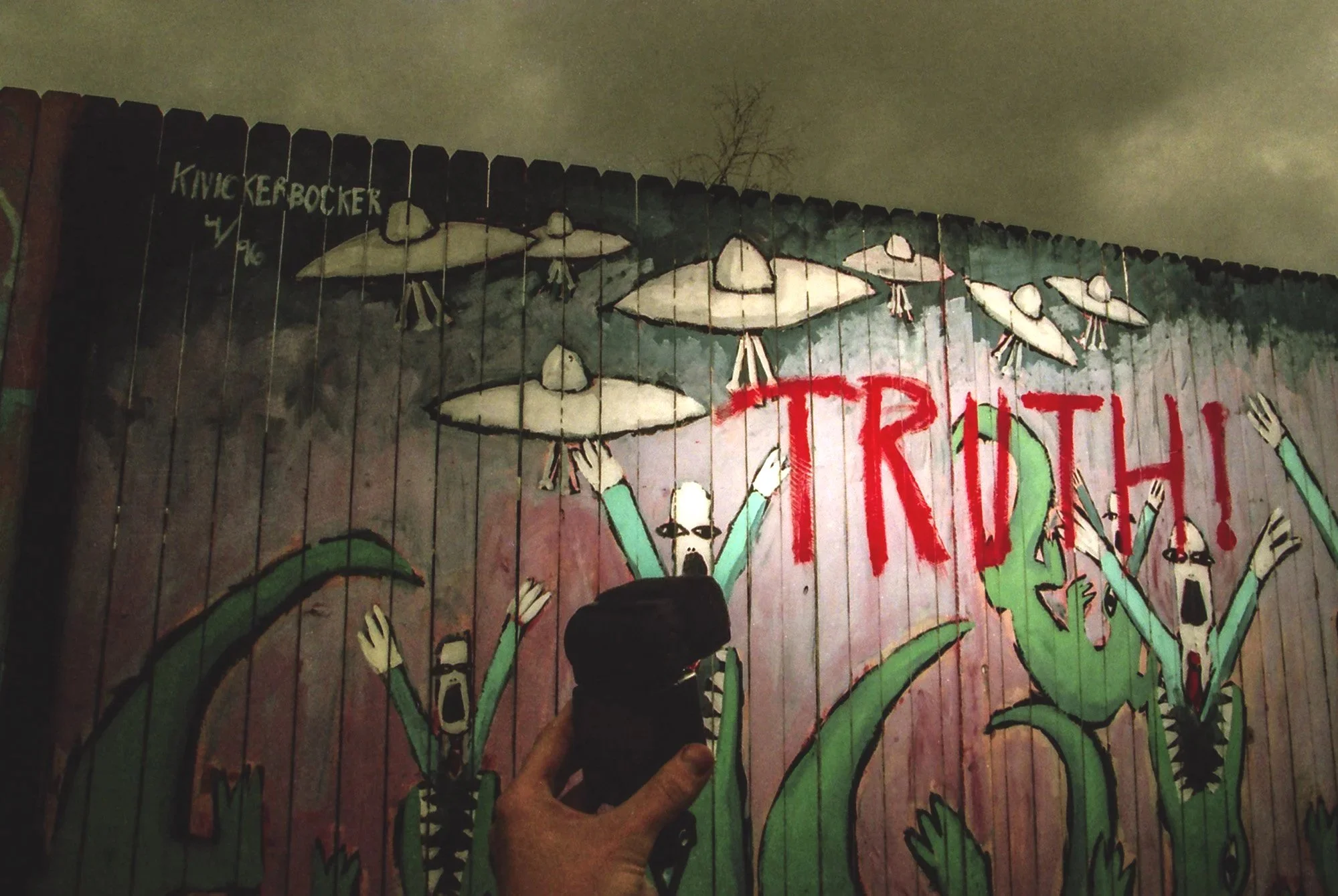
Photo by Tom Burton
Truth!
Above the alligators and just below the flying saucers, truth appeared.
Recently, the single word “TRUTH!” was painted in vivid red on an Orange Avenue fence mural in Orlando near the railroad tracks north of Marks Street. The existing painting is a work by Chuluota, Florida artist, Carl Knickerbocker, and was painted more than three years ago. In the painting “Florida Millennium,” cartoon-like businessmen are devoured by gators as UFOs sweep in from the skies.
The mural occupies a prime corner spot on a construction site fence. When called, Knickerbocker hadn’t heard about the “TRUTH!” but he was impressed.
“They tagged it,” he said. “Cool. That’s all right.”
Tags are original graffiti artwork. Years ago, the first bandit artists would paint their nicknames on city walls, creating a “tag.” Knickerbocker’s mural is inspired by graffiti artists, as are most of the other artworks on the fence. In the last few years, some of those paintings have been painted over or removed. A few have been tagged. This is the first change to the “Florida Millennium” piece.
If the words of the prophets are indeed written on the subway walls, then “TRUTH!” could be a spiritual message, a response to Y2K insanity or even a reference to the X-Files television series.
In any case, “TRUTH!” was fitted into Knickerbocker’s mural without covering any key design elements of the original.
“It was a respectful tagging,” said Knickerbocker. “What a wonderful thing.”
A version of this story appeared in the Orlando Sentinel in January 2000.
By Tom Burton